
How to Setup an AI Center of Excellence: Strategy, Structure, and Best Practices
Summary
An AI Center of Excellence (AI CoE) is a dedicated, expert team that drives consistent, strategic, value-focused AI adoption across an enterprise. Building one starts with executive sponsorship and strong leadership, then a governance model that makes AI programs scalable, compliant, and embedded in core business processes. This guide covers what an AI CoE is, how to set one up step by step, and the best practices that keep it delivering value. In short:
- What it is — A central department owning AI knowledge, planning, governance, and infrastructure for the whole organization.
- Why it matters — It turns isolated AI experiments into a long-term competitive advantage.
- How to build it — Define strategy and vision, structure a multidisciplinary team, set a governance model, then build processes and infrastructure.
- Best practices — Start small and scale, align with business goals, share knowledge widely, and lead with governance and ethics.
What is an AI center of excellence (AI CoE)?
An AI Center of Excellence (AI CoE) is a specialized department that serves as a company’s central point of contact for AI knowledge, planning, management, and assets. In plain terms, the AI CoE meaning most enterprises use, it’s the team responsible for maximizing the effectiveness of AI resources and ensuring responsible stewardship of AI across the organization.
What does an AI CoE do? Key functions and features
An AI CoE’s core functions include:
- Alignment with business objectives — Brings together the right talent, tools, and technology for AI adoption, and ties each initiative to strategic objectives that deliver measurable business value.
- Governance and compliance — Defines standardized frameworks, KPIs, and policies for ethical AI use, data privacy, and adherence to local and international regulations.
- Technical enablement — Provides and manages AI infrastructure (cloud platforms, ML frameworks, data pipelines), freeing individual teams to focus on core innovation.
- Talent development — Attracts, develops, and retains AI talent through training and continuous learning, uniting data scientists, ML engineers, and governance experts for consistent outcomes.
- Knowledge sharing and training — Creates a culture of lifelong learning with a central store of AI knowledge, resources, and tools.
- Scaling and innovation — Accelerates experimentation and digital transformation by supporting pilots and scaling successful AI solutions.
- Business integration — Bridges technical teams and business stakeholders so AI is both technically sound and commercially impactful.
- Risk mitigation — Ensures ethical, responsible, legally compliant AI through its governance framework.
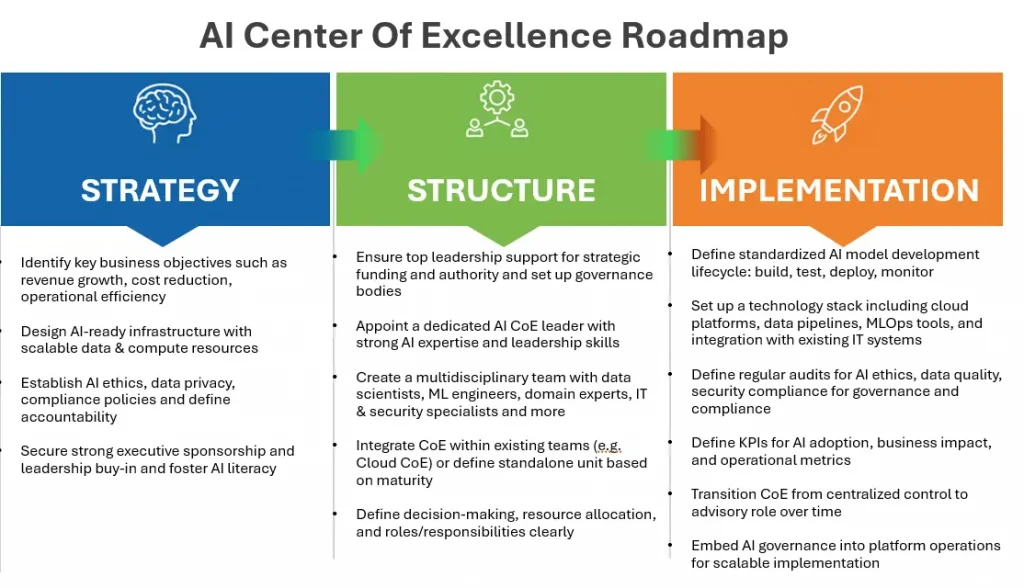
How do you set up an AI center of excellence?
Setting up an AI Center of Excellence follows five key steps, beginning with strategy and ending with the operating model that sustains it.
Step 1: How do you define AI CoE strategy and vision?
Start by identifying high-value use cases that solve real business problems, improving customer service, optimizing supply chains, or increasing operational efficiency. Set clear objectives, define KPIs to measure success, and establish a framework for ethical AI use and governance. A strong vision ensures every AI project has a purpose tied to company success.
Step 2: How should you structure your AI CoE team?
Structure determines effectiveness. Appoint an experienced AI leader to set policy and bridge technical and business teams. Build a multidisciplinary team spanning data science, machine learning, governance, security, and key business domains, with representation from IT, legal, operations, and business units.
Step 3: What governance and operating model should an AI CoE use?
Establish clear roles, decision rights, and accountability. Choose between a centralized model (better early-stage) and an advisory model (better at maturity) based on current needs.
Step 4: What processes and infrastructure does an AI CoE need?
Develop standards for project intake, data governance, ethical AI practices, and knowledge sharing. Provide robust technical infrastructure, cloud and data pipelines, to support scalable AI initiatives.
Step 5: How do you foster collaboration across the AI CoE?
Establish regular communication channels and collaboration frameworks so alignment and knowledge transfer continue across teams.
What Are the Best Practices for AI CoE Success?
Establishing an AI CoE is only the first step. Long-term success depends on a set of AI CoE best practices that ensure consistent value.
Start small and scale
Begin with small, clear projects rather than complex, high-risk ones. Quick wins build credibility and demonstrate AI’s value, after which the CoE can scale to more transformative initiatives. This phased approach mitigates risk.
Prioritize and align with business goals
Meet regularly with business unit leaders to find where AI delivers the most value, keeping the CoE focused on problems that affect the bottom line.
Foster collaboration and knowledge sharing
An AI CoE should never operate in a silo. Embed CoE members in business teams, provide training and tools, and democratize AI by sharing data, tools, and best practices organization-wide.
Focus on governance and ethics
Successful AI CoEs build models responsibly. Set clear rules from the start for data protection, model transparency, and ethical AI. A robust governance framework keeps AI systems fair, unbiased, and compliant, protecting reputation and building trust.
FAQs
What is an AI Center of Excellence in simple terms?
An AI CoE is a central team that owns AI strategy, governance, infrastructure, and knowledge for an entire organization, so AI is adopted consistently and responsibly rather than in isolated pockets.
What does AI CoE stand for?
AI CoE stands for AI Center of Excellence — a dedicated unit that centralizes AI expertise and governance across a company.
How long does it take to set up an AI Center of Excellence?
It varies by organization size and ambition, but most start with a small pilot phase before scaling, so early value can appear within months while full maturity takes longer.