
How to Set Up a Next-Generation GCC in 2026: A 12-Month Roadmap
The era of Global Capability Centers (GCCs) as mere cost-arbitrage back offices has officially ended. In 2026, the next-gen GCC functions as the central nervous system of the global enterprise, owning end-to-end product roadmaps, spearheading Agentic AI orchestration, and serving as the primary hub for digital trust. For leadership, the challenge is no longer why but how. Setting up a global business services (GBS) hub requires a shift from a transactional mindset to a capability-led strategy. This 12-month roadmap, built on modern GIC consulting frameworks, provides a phased blueprint for an offshore business setup that delivers strategic value from day one.
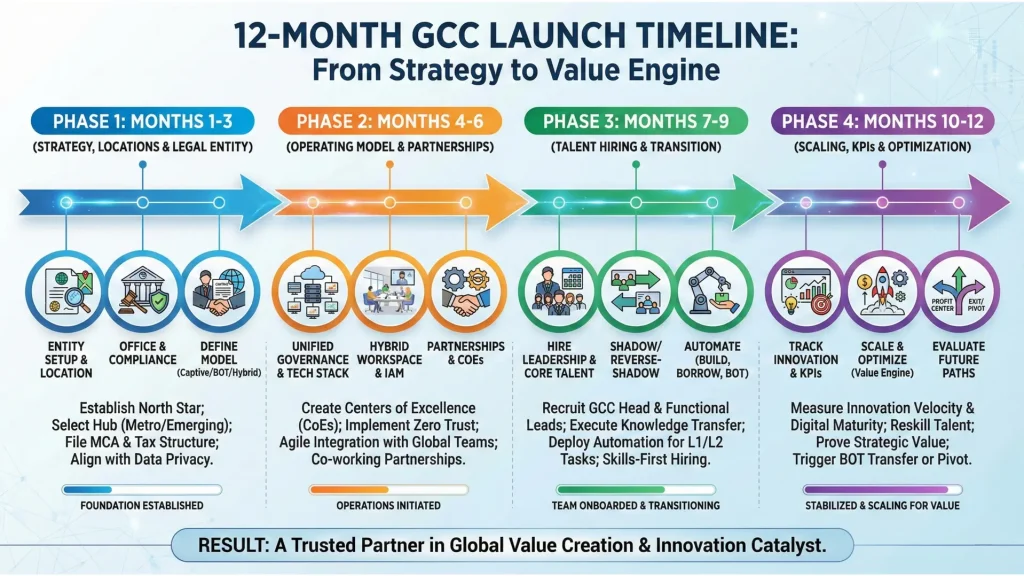
Phase 1 – Strategy, Locations, and Legal Entity
The first 90 days are critical for establishing the North Star of the center. In 2026, successful centers avoid the “lift-and-shift” trap, opting instead for “transform-and-shift.” Leadership must decide if the GCC will be a captive (fully owned), a build-operate-transfer (BOT), or a hybrid model. Most next-gen entities choose the wholly owned subsidiary (WOS) model for maximum control over intellectual property (IP) and long-term scaling. Location selection has evolved beyond Tier-1 metros. While Bengaluru and Hyderabad remain dominant for AI and Software as a Service (SaaS), savvy firms are exploring emerging tech hubs:
- Specialized Hubs: Ahmedabad for FinTech, Pune for Engineering and Analytics.
- Cost Efficiency: Tier-2 cities like Jaipur or Coimbatore offer 15–20% lower operational costs while tapping into fresh, loyal talent pools.
The legal track runs in parallel with location scouting. This involves:
- Incorporation: Filing with the Ministry of Corporate Affairs (MCA).
- Tax Structuring: Establishing transfer pricing benchmarks and registering for GST (Goods and Services Tax).
- Compliance: Aligning with the Digital Personal Data Protection Act (DPDPA) to ensure compliance with global data privacy standards.
Phase 2 – Operating Model and Partnerships
With the legal entity in place, the focus shifts to the how of daily operations. Phase 2 defines the relationship between the parent headquarters and the new center. A next-gen offshoring strategy framework moves away from siloed functions. Instead, it creates Centers of Excellence (CoEs).
- Unified Governance: Establishing a single version of the truth through integrated ERP and AI-driven reporting dashboards.
- Agile Integration: Ensuring the GCC teams are not shadow teams, but are integrated into the global sprint cycles and decision-making loops.
In 2026, the workspace is hybrid-first. This requires:
- Zero Trust Architecture: Implementing robust Identity and Access Management (IAM) to protect distributed workforces.
- Smart Workspaces: Leveraging flexible co-working partnerships for speed-to-market before committing to long-term Capital Expenditure (CapEx) in physical real estate.
Phase 3 – Talent Hiring and Transition
Talent is the make-or-break variable. In 2026, the hiring market is skills-first rather than role-first. The first hires should not be junior developers, but the GCC Head and functional leads. These individuals must combine a global-local perspective, balancing an understanding of regional talent ecosystems with the ability to engage in the strategic discourse of the home office. To build an offshore team efficiently, next-gen GCCs use a three-pronged hiring approach:
- Build: Recruit permanent staff for core product and IP-heavy roles.
- Borrow: Use contractual or gig talent for specialized, short-term AI or cloud migrations.
- Bot: Automate repetitive L1 and L2 support tasks from the outset to keep the headcount lean and focused on high-value work.
The transition phase involves a structured shadow/reverse-shadow process, where local teams take over processes while maintaining performance parity with the onshore teams.
Phase 4 – Scaling, KPIs, and Exit Options
The final phase moves from setup to optimization. A GCC is a living entity that must prove its value through measurable outcomes. Beyond simple headcount and cost savings, next-gen GCCs are measured on:
- Innovation Velocity: Number of patents filed or new product features owned by the GCC.
- Digital Maturity Index: The percentage of processes optimized by AI and automation.
- Talent Capability Index: The speed at which the center can reskill employees for emerging tech stacks.
A mature GCC setup roadmap includes exit or pivot options. For firms that started with a BOT model, month 12 is often the trigger point for the transfer phase. For captive centers, this is the time to evaluate if the GCC should evolve into a global profit center, selling services to other internal business units or external partners. The most successful GCCs of 2026 are those that move from cost centers to value engines within the first year. They don’t just execute tasks, they solve global business problems.
Conclusion
Setting up a GCC is a long-term commitment that rewards intentional design and steady execution. A well-structured 12-month roadmap enables organizations to align culture, governance, and operating models from the outset, reducing friction as the center scales. When built with purpose, a GCC becomes more than an offshore presence, it emerges as a trusted partner in value creation. Over time, it serves as a catalyst for innovation, talent development, and enterprise-wide transformation, shaping the organization’s growth trajectory for years to come.