
How a Supply Chain Center of Excellence Prevents Shortages
Summary
Supply Chain CoEs turn volatility into control—preventing shortages through foresight, not reaction
-
Fragmented supply chains create blind spots; siloed data delays response, leading to costly, reactive decisions and missed mitigation windows.
-
A centralized CoE unifies data, governance, and standards, giving enterprises real-time visibility and a single source of truth across regions.
-
Predictive analytics enables proactive risk mitigation, using AI-driven forecasting to anticipate disruptions and trigger early actions like buffer stocking and diversified sourcing.
-
Centralized vendor management reduces dependency risks and increases bargaining power, making CoE-led enterprises preferred customers during shortages.
Recommendation: Shift from decentralized logistics to a centralized Supply Chain CoE to institutionalize resilience, reduce time-to-recover, and move from reactive firefighting to proactive supply assurance.
The contemporary global supply chain is no longer a straight line from point A to point B, rather, it is an unstable, interconnected web that is vulnerable to abrupt market turns, geopolitical upheavals, and climate events. The just-in-time efficiency of the last ten years has exposed the weakness of many businesses: a lack of resilience. A single node failure sends shockwaves through the entire network, resulting in the one thing every leader dread: ongoing shortages.
Innovative companies are shifting away from reactive logistics to address this. In order to turn supply chain management from a back-office operation into a strategic powerhouse, they are building a Supply Chain Center of Excellence (CoE), a centralized hub of knowledge, technology, and governance.
The Vulnerability of Fragmented Supply Chains
Many large-scale enterprises still operate with fragmented supply chains, where regional offices, individual product lines, or disparate business units manage their own procurement and logistics.
Within a fragmented framework, data is compartmentalized. For instance, should a crucial component manufacturer in Southeast Asia experience a shutdown, the European division may be informed, whereas the North American division remains unaware until their inventory is depleted. This absence of comprehensive visibility implies that by the time a shortage is recognized, the opportunity for remediation has already been lost. Consequently, fragmented chains are intrinsically reactive, compelling leaders to seek spot-buy solutions at inflated expenses, thereby diminishing profit margins and undermining brand trust.
How a Supply Chain Center of Excellence Creates Stability
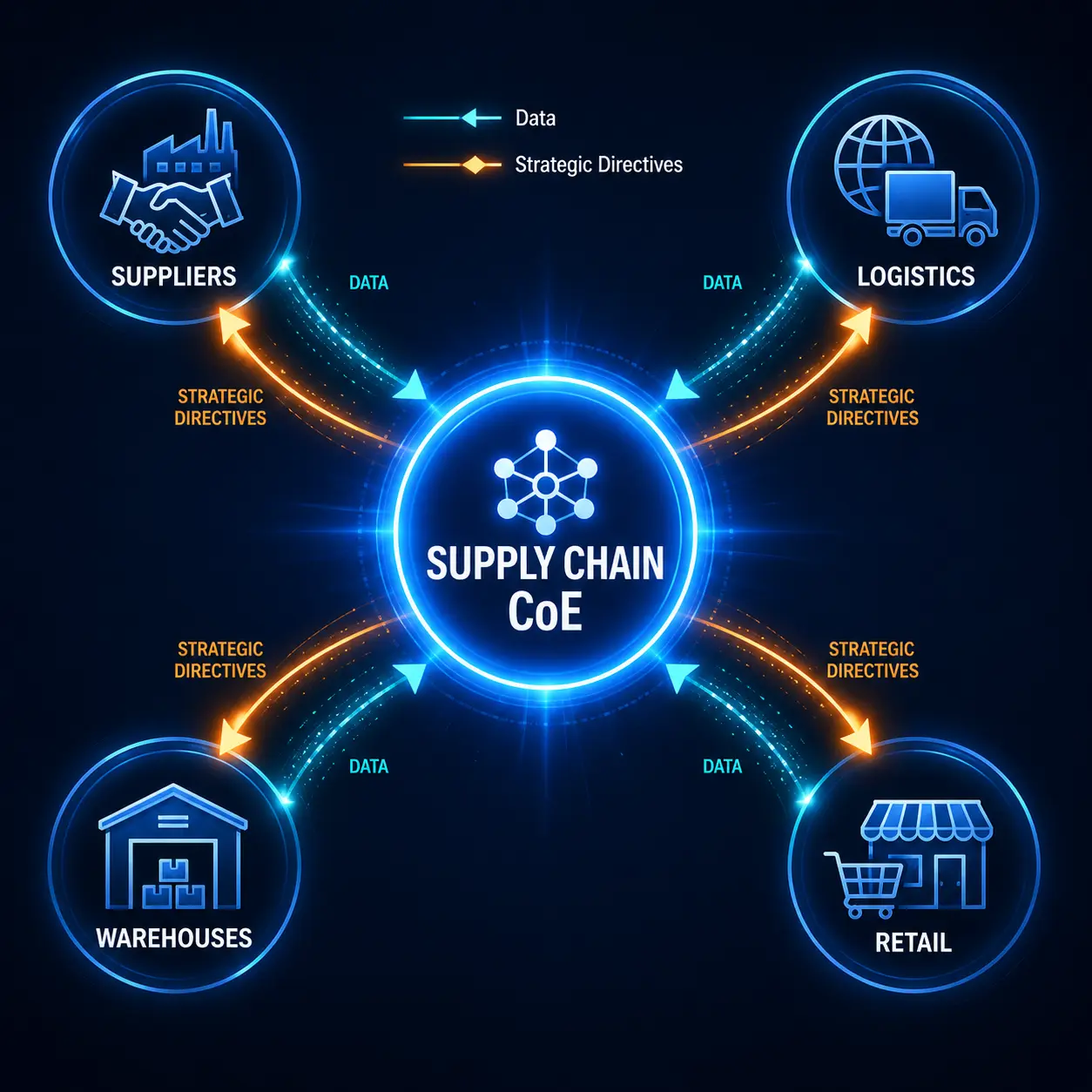
A Center of Excellence acts as the brain of the operation. Rather than physically moving every box, the CoE sets the standards, selects the technology, and provides the analytical oversight for the entire global footprint. It replaces chaos with a unified framework, ensuring that the enterprise speaks one language when it comes to inventory, risk, and movement.
Predictive Analytics & Demand Forecasting
The CoE moves the organization from hindsight to foresight. By leveraging advanced AI and machine learning, a CoE can process vast amounts of internal and external data from historical sales trends to real-time weather patterns and shipping port congestion scores. Instead of relying on intuition or last year’s spreadsheets, the CoE uses predictive modelling to simulate various scenarios. This allows the enterprise to build buffer stocks for high-risk items long before a shortage hits the news cycle. When the data suggests a 15% probability of a regional disruption, the CoE has already triggered a diversified sourcing protocol.
Centralized Global Vendor Management
Shortages often stem from an over-reliance on a single vendor or geographic region. A CoE centralizes vendor management, providing a single source of truth for supplier performance and risk profiles. By viewing the vendor landscape through a global lens, the CoE can identify concentration risks for instance, realizing that three different independent suppliers all rely on the same raw material sub-tier supplier. Centralization also grants the enterprise massive bargaining power. When a shortage occurs, a company with a CoE is often the preferred customer, securing limited inventory while smaller, fragmented competitors are left empty-handed.
Crisis Management Within a Dedicated CoE
When a crisis does strike be it a canal blockage or a sudden trade embargo the CoE serves as the mission control. In a traditional setup, crisis response is diluted across departments, leading to conflicting priorities and wasted time. Within a CoE, a dedicated crisis response team has the authority to reroute shipments, reallocate inventory between regions based on high-priority demand, and activate pre-vetted secondary suppliers. This centralized command structure reduces the time-to-recover (TTR). While others are still assessing the damage, a CoE-led enterprise is already executing a pivot.
Securing Your Enterprise’s Future Inventory
The goal is no longer just cost arbitrage it is certainty. A Supply Chain CoE provides the structural integrity required to maintain that certainty in an uncertain world. By investing in a CoE, an enterprise is not just buying a new software suite, it is institutionalizing resilience. It ensures that the knowledge gained from one disruption is codified into the strategy for the next. In the race to prevent shortages, the winner is not the company with the most inventory, but the company with the most intelligent, agile, and centralized command of its supply chain.
Establishing supply chain a CoE is the definitive move from a defensive posture to an offensive one, securing the inventory of today and the growth of tomorrow.