
How to design a future‑ready, AI‑native GCC
Summary
In 2026, GCC success is measured by capability arbitrage, not cost arbitrage—leading centers own product roadmaps, platforms, and AI-led outcomes that directly influence revenue, resilience, and competitiveness.
Future-ready GCCs embed AI into their operating fabric through human–AI workflows, sovereign GPU-grade data infrastructure, and strong AI governance that manages risk, bias, and compliance at scale.
Hybrid, multi-hub models and skills-first talent architectures let GCCs tap wider pools (Tier-2 cities, niche skills), support distributed teams with digital parity, and redeploy talent dynamically to high-impact work.
A disciplined 12–18 month roadmap—from mandate and ecosystem setup to AI infrastructure, engineering-first leadership, and integration—ensures the GCC scales quickly without sacrificing governance or long-term stability.
Recommendation: Design your GCC as an AI-native capability center from day one—anchor it in end-to-end ownership, AI-first architecture, hybrid talent models, and a phased build plan so it becomes a durable strategic advantage, not just another offshore location.
Designing a future-ready, AI-native GCC in 2026 requires moving beyond the traditional mindset. Present-day GCCs are being reimagined as high-stakes innovation hubs where AI isn’t just a tool, but the fundamental operating fabric. Enterprises now require agility, rapid innovation, and real-time decision-making intelligence – features that a transactional GCC finds challenging to deliver. This shift places new demands on GCC design.
AI-native GCCs must integrate advanced analytics, machine learning, and automation directly into their operating models to enable faster insights, adaptive execution, and resilient scalability. As competitive pressure intensifies, the GCC’s mandate expands from execution to value creation, positioning it as a strategic engine that directly influences enterprise growth, customer experience, and long-term digital advantage.
Why GCCs Must Evolve in 2026
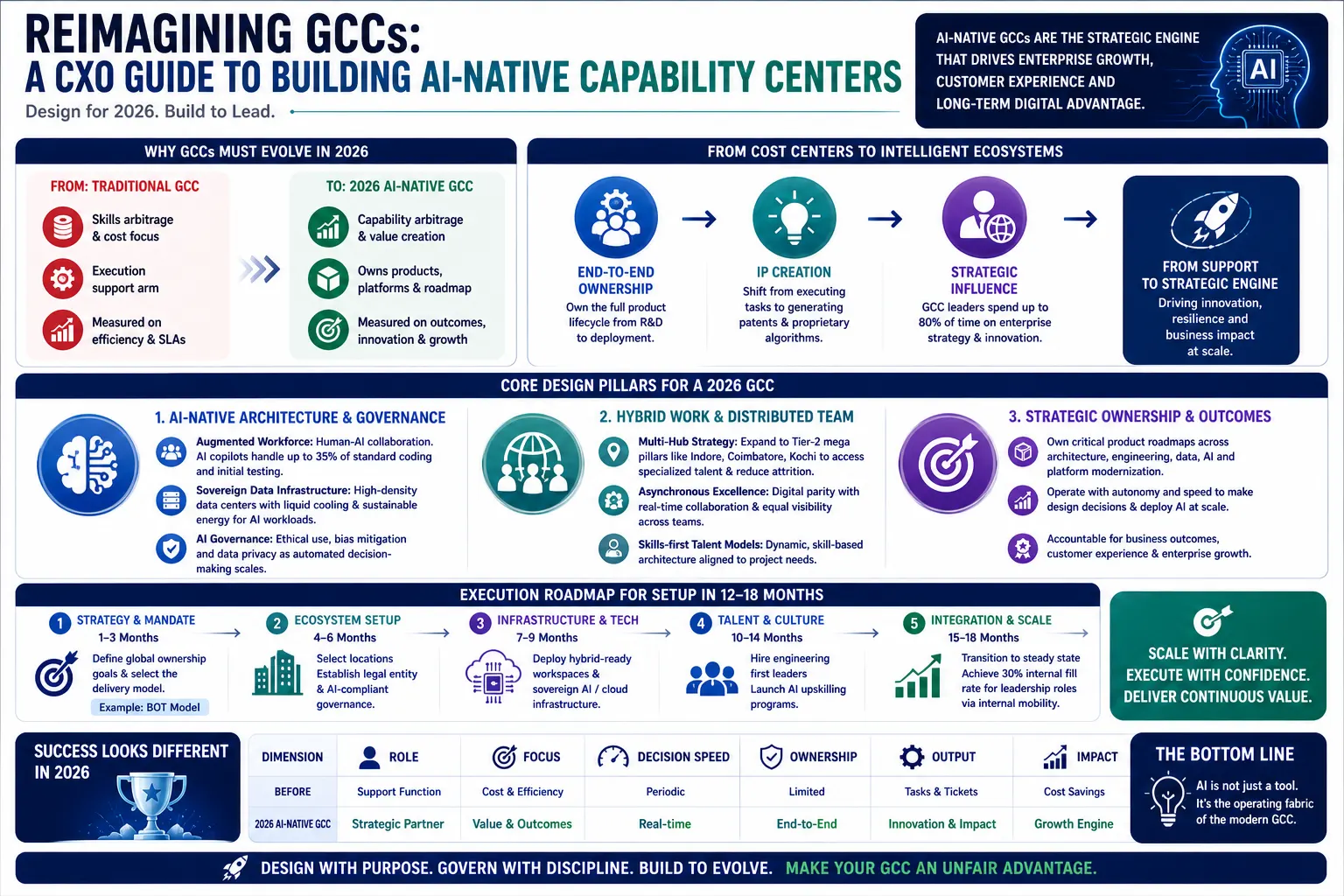
The GCC landscape has shifted decisively from skills arbitrage to capability arbitrage. In 2026, enterprises no longer evaluate GCCs solely on cost efficiency or Service Level Agreement (SLA) adherence. They measure success by the center’s ability to build differentiated capabilities, own critical product roadmaps, and deliver outcomes that directly influence revenue, resilience, and market competitiveness. Modern GCCs increasingly function as global product and platform owners rather than downstream execution arms. They lead end-to-end mandates across architecture, engineering, data, AI, and platform modernization, requiring deeper technical leadership, tighter integration with core business teams, and accountability for business outcomes instead of operational metrics.
As enterprise models decentralize and product cycles compress, GCCs must operate with greater autonomy and speed. They need the authority to make design decisions, deploy AI-driven intelligence at scale, and continuously optimize products in real time. This evolution distinguishes 2026 GCCs as strategic capability centers that power innovation, accelerate growth, and sustain long-term digital advantage.
From Cost Centers to Intelligent Ecosystems
Traditionally, GCCs were designed to manage operations efficiently and deliver cost advantages. Today, they’ve evolved into strategic ecosystems that integrate talent, technology, and data-driven intelligence to accelerate innovation and deliver tangible business impact. This evolution reflects a fundamental shift from operational efficiency to strategic value creation, redefining the GCC’s role within the global enterprise.
- End-to-End Ownership: Moving from support and execution functions to owning the entire product lifecycle, from R&D to deployment.
- IP Creation: Shifting from executing tasks to generating patents and proprietary algorithms.
- Strategic Influence: GCC leaders now hold global functional roles, spending up to 80% of their time on enterprise-wide strategy rather than just site administration.
Core Design Pillars for a 2026 GCC
To build a center that can withstand the rapid pace of technological change, enterprises must design with three specific pillars in mind. These pillars anchor the GCC’s ability to scale with confidence, absorb disruption, and continuously generate business value. Rather than reacting to external shifts, a well-designed center embeds adaptability into its core operating model. Each pillar directly supports long-term relevance by aligning talent, technology, and governance with the enterprise’s strategic objectives. Together, they ensure the GCC evolves from a static delivery engine into a resilient, innovation-led capability that remains future-ready as AI, platforms, and business models continue to advance.
AI-native Architecture and Governance
An AI-native GCC integrates AI into its DNA, not just its product output.
- Augmented Workforce: Workflows are redesigned for human-AI collaboration. For example: AI co-pilots now handle up to 35% percent of standard coding and initial testing, allowing engineers to focus on complex systems architecture.
- Sovereign Data Infrastructure: With the rise of GPU-led computing 2026 GCCs prioritize high-density data centers with liquid cooling and sustainable energy sources to power intensive AI workloads.
- AI Governance: Robust frameworks are required to manage reasoning with AI ensuring ethical use, bias mitigation and data privacy compliance as automated decision-making scales.
Hybrid Work and Distributed Team
The office is longer a mandatory daily destination but a collaboration hub.
- Multi-Hub Strategy: GCCs are expanding beyond Tier-1 metros into Tier-2 Mega pillars like Indore, Coimbatore and Kochi to tap into specialized talent and reduce attrition.
- Asynchronous Excellence: Architecture is designed for digital parity ensuring that remote team members have the same visibility, leadership access and real time collaboration tools as those in the office.
- Skills-first Talent Models: Moving away from the rigid job descriptions toward a dynamic, skill-based architecture where talent is deployed based on project specific technical requirements.
Execution Roadmap for Setup in 12-18 Months
Setting up an AI-native GCC is a phased journey that balances speed with long-term stability. Enterprises must accelerate early value creation while simultaneously establishing the structural foundations required for scale, security, and sustained performance. Each phase builds deliberately on the last, ensuring rapid momentum does not compromise architectural integrity or governance discipline.
|
PHASE |
TIMELINE |
KEY MILESTONES |
|
1. Strategy & Mandate |
1-3 |
|
|
2. Ecosystem Setup |
4-6 |
|
|
3. Infrastructure & Tech |
7-9 |
|
|
4. Talent & Culture |
10-14 |
|
|
5. Integration & Scales |
15-18 |
|
This phased approach ensures the AI-native GCC scales with clarity, control, and confidence. By aligning strategic intent with disciplined execution at every stage, enterprises reduce risk, accelerate value realization, and institutionalize AI as a core business capability rather than a peripheral initiative. The result is a resilient, self-sustaining center that continuously strengthens enterprise innovation, leadership depth, and competitive advantage over time.
Conclusion
The question is no longer whether to build a GCC, but how intentionally it is designed. As AI reshapes competitive advantage at unprecedented speed, the first 18 months present a critical opportunity to position a GCC as a strategic growth engine that drives sustained enterprise value.
Enterprises that treat GCCs as AI-native capability centers from day one position themselves to lead, not follow. They embed intelligence into execution, elevate ownership to outcomes, and create talent ecosystems that continuously renew themselves. As 2026 approaches, the most successful organizations will be those that view their GCC not as a location strategy, but as a long-term enterprise advantage designed with purpose, governed with discipline, and built to evolve.
The opportunity is clear. The way a GCC is designed will be integral to its success.