
AI Training at Scale: Building and Measuring Effective Enterprise Learning Programs
Summary
Scaling role-based AI training is the defining factor for enterprise market leadership.
Maximize economic impact: Unlocking AI’s $4.4 trillion potential requires upskilling a resilient, future-ready workforce, rather than just acquiring new technology.
Customize the curriculum: Effective programs demand flexible, role-specific learning paths tailored to distinct business functions like marketing, finance, and HR.
Track business outcomes: Success relies on choosing integrated platforms with robust analytics to tie learning engagement directly to productivity gains and operational cost reductions.
Cultivate a learning culture: Embed microlearning into daily workflows and combine peer cohorts with active leadership buy-in to sustain long-term engagement.
Recommendation: Audit your workforce’s current AI literacy and launch a role-specific, cohort-based pilot program to identify and empower internal AI champions.
Artificial Intelligence (AI) isn’t just some ultramodern buzzword anymore. It is now the center of business strategy. What used to be a simple cutting-edge technique has now become standard for enterprises that are aiming to stay on top and efficient by keeping customers engaged and introducing real innovation.
To remain competitive, enterprises must invest in scalable artificial intelligence (AI) training programs not merely as a technological upgrade but as a proactive step toward building a resilient, future-ready workforce.
Why AI Training at Scale Matters for Enterprises
For enterprises, the demand for large-scale AI training is kicking into high gear, all thanks to the major thrust for digital transformation. Industry estimates place the annual global economic impact of artificial intelligence at an astounding $4.4 trillion. Such an impact is truly groundbreaking.
Here’s the bottom line: none of those benefits mean much unless companies have the skilled teams to roll out, manage, and expand their AI projects.
Enterprises today are up against some serious challenges: Enterprises must move quickly to upskill large, globally distributed workforces spanning multiple functions and diverse backgrounds. It’s all about making sure every team member can add value in this new era of AI-powered business.
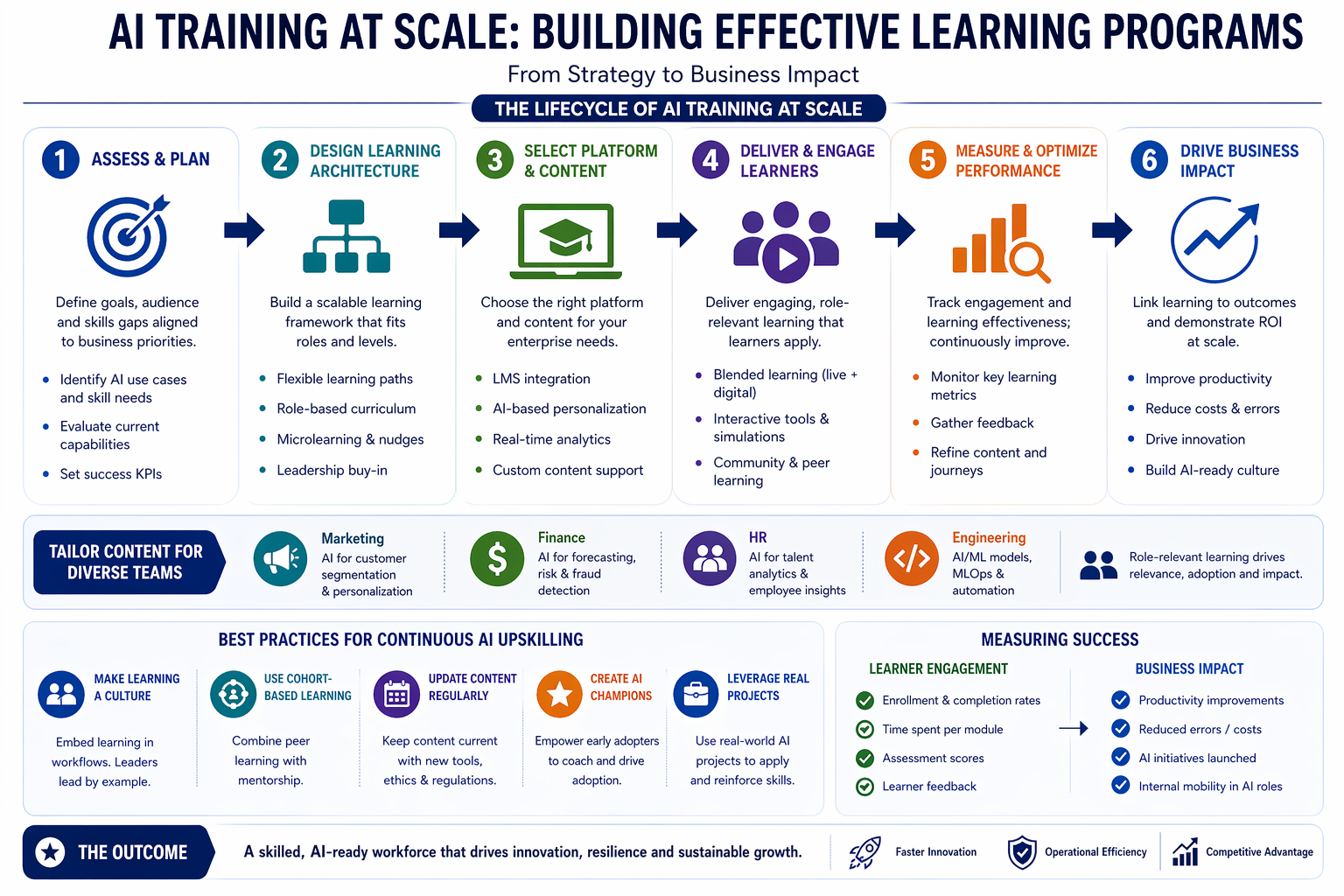
Key Elements of Scalable AI Learning Programs
- Flexible Learning Paths: For Enterprise learning programs, courses are structured but still offer flexibility, letting employees start where they need, whether that’s basic or advanced.
- Role-Based Curriculum: Training is customized and matched to specific job functions. For Example, product managers, data scientists, marketing, and HR teams all get relevant, targeted content.
- Integrated Learning Tools: Everything’s accessible on one platform: video lectures, interactive seminars, regular assessments, and even introductions to AI simulators. This way, teams can learn and apply new skills seamlessly.
- Microlearning & Nudges: Focused lessons are paired with timely reminders, helping employees retain information and finish their training.
- Leadership Buy-In: Senior leaders actively get involved in this enterprise learning programs, ensuring company-wide alignment and encouraging participation at every level.
Choosing the Right AI Learning Platforms
Choosing the right platform can openly determine the success or failure of your enterprise AI training strategy. AI learning platforms like Coursera for Business, edX for Enterprise, and Skillsoft deliver intentionally crafted learning paths designed for enterprises.
Alternatively, if the teams are deeply technical, Platforms like DataCamp, Udacity, and Microsoft Learn are aligned to their unique requirements
For large-scale deployments, look for platforms that support:
- Seamless LMS integration
- Real-time analytics dashboards
- Custom content capabilities
- AI-based personalization and recommendations
Some enterprises have joined forces with platforms like upGrad and Great Learning to customize training through a balanced mix of instructor-led sessions and digital learning modules.
Customizing Content for Diverse Teams
AI learning isn’t a cookie-cutter solution. Different teams like marketing, finance, and HR need material that makes sense for what they do every day. While marketing might focus on AI-led customer segmentation, HR teams would find more value in talent analytics and people-focused AI use cases.
Measuring Success: Metrics for AI Upskilling
A scalable program for AI upskilling holds value only if it drives meaningful outcomes. Measuring both learner engagement and business impact is essential.
Tracking Adoption and Engagement
Key metrics include:
- Enrolment and course completion rates
- Time spent per module
- Assessment and quiz scores
- Feedback from learners
Assessing Business Impact
To justify the ROI of AI training, link learning to business outcomes:
- Productivity improvements
- Reduction in errors or operational costs
- Innovation KPIs (e.g., number of AI-driven initiatives launched)
- Internal mobility and promotion rates in AI-centric roles
Leading tech firms like Google and Amazon are setting the standard with internal programs such as “Learn with Google AI” and “Machine Learning University,” which focus on both workforce upskilling and measurable business impact.
Best Practices for Continuous AI Upskilling
- Make Learning a Culture: Embed AI learning into everyday workflows. Encourage leaders to model learning behaviour.
- Use Cohort-Based Learning: Combine peer learning with guided mentorship for higher engagement.
- Update Content Regularly: AI evolves rapidly; ensure content stays current with new tools, ethics frameworks, and regulations.
- Create AI Champions: Identify early adopters who can serve as internal coaches or mentors.
- Leverage Internal Projects: Assign real-world AI tasks or pilots as capstones to reinforce learning.
Conclusion
Let’s be honest, Artificial Intelligence (AI) training isn’t a box to tick. It’s a core strategic initiative. In a landscape where everyone’s racing to “do AI,” the real differentiator is who empowers their workforce with the right tools and know-how.
Companies funding relevant, modular, results-oriented learning pathways transform their people into drivers of innovation, resilience, and sustained growth. Those who master the speed of learning and even greater speed of scaling will own tomorrow’s market.