When a Shared Service Center Should Evolve into a GCC
For decades, the shared service center (SSC) model has been a cornerstone of enterprise operating models, built around scale, process excellence, and cost-effective operations. However, in a global economy defined by rapid digital disruption and a scarcity of specialized talent, the engine room is increasingly moving to the cockpit.
As organizations mature, many find that the traditional SSC model, while efficient, has its own limitations. The transition to a GCC represents a fundamental shift in philosophy: moving from a cost-center mindset to a value-creation engine. This evolution is no longer just a trend for tech giants, it is a strategic imperative for any multinational enterprise looking to turn its global footprint into a competitive advantage.
Shared Services vs GCC: The Strategic Difference
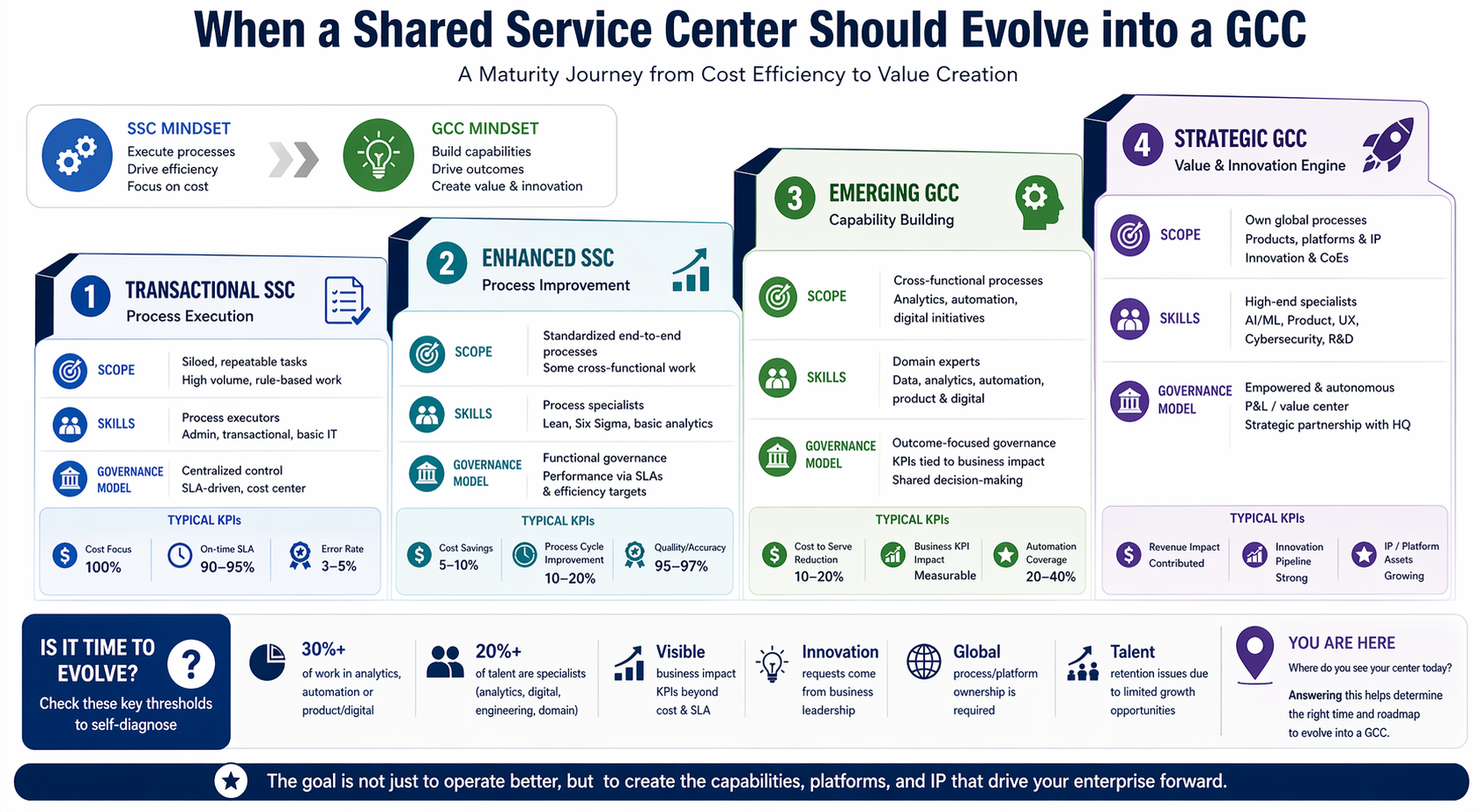
While the terms are occasionally used interchangeably, the structural and psychological differences between an SSC and a GCC are profound. An SSC is typically designed to execute, a GCC is designed to innovate.
From Transactional Efficiency to Capability Building
The traditional Shared Services Center (SSC) reflects an industrial-era model applied to knowledge work, with performance largely measured by volume and cost per transaction. Success is measured by how efficiently the center can process invoices, manage payroll, or handle basic IT tickets. In contrast, a GCC focuses on capability building. Instead of just executing a process, the GCC seeks to improve the underlying technology and logic of that process. Instead of scaling manual effort, GCCs scale intelligence. While SSCs rely on large teams for data entry, GCCs deploy specialists to automate workflows and extract insights, shifting the mandate from task delivery to platform and IP creation.
Ownership of Outcomes vs Service-Level Delivery
The relationship between a headquarters and an SSC is often structured and process-driven, guided by clearly defined Service Level Agreements (SLAs). The SSC is a vendor, even if it is an internal one. If the tickets are closed on time, the SSC has done its job. A GCC operates on a model of outcome ownership. Rather than focusing on SLAs, GCCs are measured by their impact on business key performance indicators (KPIs). A GCC doesn’t just manage the supply chain data, it owns the optimization of inventory levels globally. This shift in accountability fosters a sense of partnership rather than subservience, allowing the center to act as a global headquarters for specific business functions.
Signals That Your Shared Service Center Has Outgrown Its Model
How does a leadership team know when the SSC model has reached its expiration date? The signs are usually found in the friction between the center’s capabilities and the business’s needs.
Rising Complexity and Cross-Functional Scope
When an SSC begins handling borderless problems that require deep institutional knowledge, the transactional model starts to break. If the center is no longer just processing travel expenses but is instead designing the global travel policy and negotiating vendor contracts, it has moved into the realm of a GCC. As the scope shifts from siloed tasks to end-to-end processes such as record-to-report or hire-to-retire, the need for a more sophisticated governance model becomes undeniable.
Growing Demand for Analytics, Digital, and Product Skills
If a center’s hiring profile shifts from administrative support to specialized roles such as UX designers, AI engineers, or cybersecurity experts, the traditional SSC framework may no longer be the most enabling model for that talent. Top-tier talent does not want to work at an organization where their value is measured by time-tracking. They want to work in an environment that prizes innovation. When the business starts asking the center for predictive analytics instead of historical reports, the evolution to a GCC has already begun in spirit, if not yet in name.
Business Triggers for Evolving into a GCC
External market pressures and internal mandates often serve as the catalysts that force a company to officially transition its model.
C-suite Expectations for Innovation and Speed
Today’s leaders are less impressed by 5% year-on-year cost savings in the back office. They are looking for agility. In a world where product lifecycles are shrinking, the C-suite expects global centers to contribute to the top line. A GCC can accelerate time to market by providing 24/7 R&D cycles or by housing centers of excellence (CoEs) that pilot new technologies before they are scaled globally.
Need for Global Process and Platform Ownership
Modern enterprises are moving away from fragmented regional systems toward unified global platforms. Managing these global platforms from a central HQ in New York or London is often impractical and expensive. A GCC provides a logical home for global process owners. By centralizing the ownership of the platform in a GCC, the organization ensures that the people closest to the data and the technology are the ones making the strategic decisions about its future.
How to Manage the Evolution Journey
Transitioning from an SSC to a GCC is not a lift and shift operation, it is a fix and flip transformation that requires a multi-year roadmap.
Redesigning Org Structure, Roles, and Governance
The first step is moving away from the hub and spoke model where the center merely takes orders. The new governance structure must give GCC leaders a seat at the table. This often involves:
- Dual Reporting Lines: Employees report both to the GCC lead and the global functional head.
- Strategic Role Mapping: Moving away from generic process associate titles to product owners and solution architects.
- Investment Budgets: Allowing the GCC to have its own R&D budget to experiment with automation and AI without needing HQ approval for every minor spend.
- Independent Decision-Making Authority: Empowering the GCC to make operational and innovation decisions locally, within defined governance frameworks, to accelerate execution and responsiveness.
Rebranding, Culture, and Leadership Upgrades
Perhaps the most difficult part of the evolution is the cultural shift. An SSC culture is one of compliance, a GCC culture is one of curiosity.
- Leadership: The GCC-site leader must have a thorough understanding of the business; its goals in setting up the GCC and the metrics on which the GCC’s success will be measured.
- Employer Value Proposition (EVP): To attract top-tier talent, the center must rebrand itself. It must be marketed as a hub of innovation where a developer or data scientist can have a global impact, rather than just a remote support office.
- Continuous Learning: A GCC must invest heavily in upskilling. If the goal is to own global outcomes, the staff must be trained in design thinking, agile methodologies, and the latest technological stacks.
The transition from Shared Services Centers (SSCs) to Global Capability Centers (GCCs) represents a fundamental shift in enterprise value creation, from operational efficiency to strategic impact. SSCs were designed for a simpler era focused on scale and cost control, but today’s environment demands integrated intelligence, deeper collaboration, and global influence. Enterprises that navigate this shift effectively are not just reducing expenses, they are creating the platforms, talent engines, and intellectual property that will define their future growth.